 Godsunchained
 connects strategic card battles with tradable NFT cards
Godsunchained is a free-to-play strategy card game where players build decks, battle opponents, and collect cards that can exist as tradable NFTs. Six domains shape different tactics. Free cards provide a starting collection, while NFT ownership, forging, and GODS rewards connect the game to its blockchain economy.
Playable cards and owned NFTs
Playable cards supply game pieces, while NFTs, or non-fungible tokens, represent individual blockchain assets that a compatible wallet can hold and transfer. Plain-quality cards remain off-chain, so their availability in a game collection doesn't make those copies transferable.
The distinction applies to the particular copy. Buying an NFT of a card doesn't turn every copy of that design into an NFT.
Hypothetical example: A player expects every card in a playable deck to appear as an asset in their wallet. Their collection includes a free off-chain card and an owned NFT card.
The free card can support deck building without creating a wallet token. The NFT card combines its game use with a transferable asset record.
The missing wallet entry for the off-chain card doesn't indicate a lost NFT.
Six domains and their tactical roles
The six domains group cards around different tactical approaches, from early pressure to attrition and board control. A standard constructed deck has 30 cards drawn from the chosen god's domain or the Neutral pool. Each player aims to reduce the opposing god's health to 0 while keeping their own god alive. Individual card effects determine the available interactions, and mana costs restrict which plays fit a turn. Creatures, spells, and relics give those approaches different ways to affect a match.
- Death turns sacrifices and attrition into tools for wearing down an opponent.
- Nature develops board presence with beasts, plants, and regeneration.
- War favors early pressure, direct damage, and weapons.
- Light supports durable allies with healing and defensive effects.
- Deception interferes with opposing plans through stealing and manipulation.
- Magic uses spells and board control to respond to threats.
These identities help explain card synergies without fixing every deck to a single tactic. The relevant interaction comes from the card text and the match rules.
Free cards, packs, and individual purchases
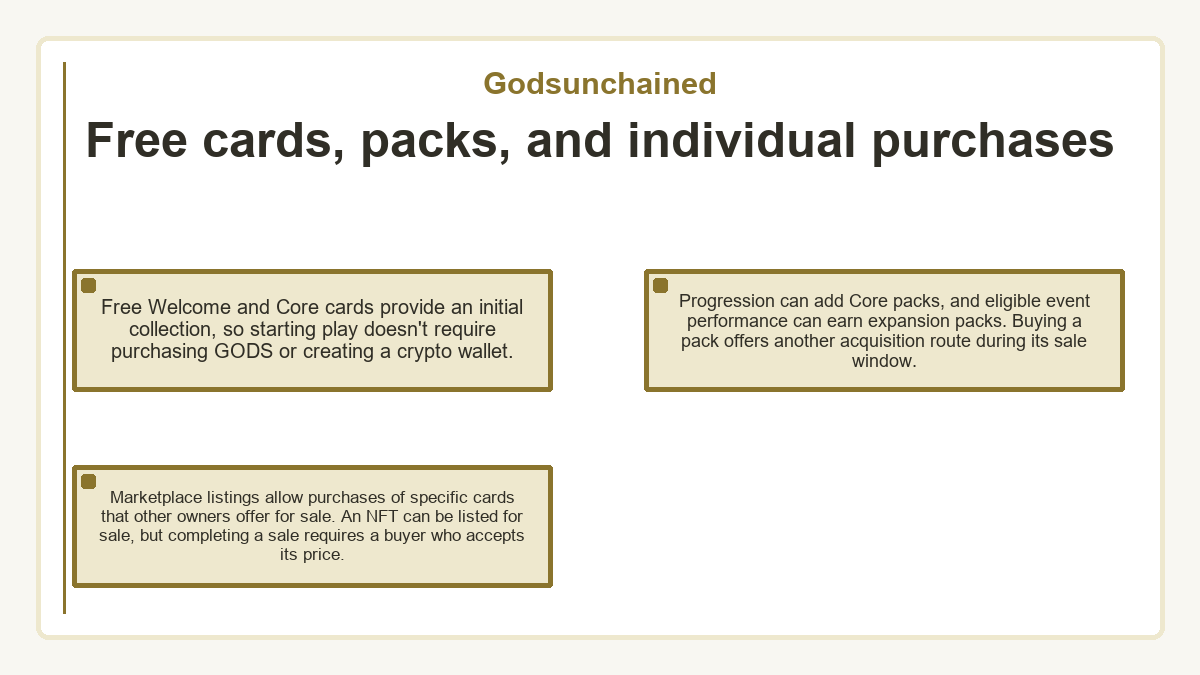
Free Welcome and Core cards provide an initial collection, so starting play doesn't require purchasing GODS or creating a crypto wallet. Progression can add Core packs, and eligible event performance can earn expansion packs. Buying a pack offers another acquisition route during its sale window. Marketplace listings allow purchases of specific cards that other owners offer for sale. An NFT can be listed for sale, but completing a sale requires a buyer who accepts its price.
Which modes use cards from your collection?
Ranked and Conquest use constructed decks, while Sealed supplies a randomized pool from which players build a deck for that run. Sealed therefore tests deck building within the supplied pool. Its paid entry is separate from free access to the basic game, and its available card pool can rotate. The iOS and Android companion app supports Ranked, Solo, and Casual. It lacks the Sealed, Forge, Gauntlet of the Gods, and Daily Play & Earn features available on PC and Mac.
Conquest uses five-match runs with a player's own deck and requires rank 10 or higher. The mode charges for entry and scales rewards with wins. Players can change decks and gods between matches, and Mythic one-of-one cards are excluded.
GODS, Flux, and the Forge
GODS is the game's native ERC-20 token. The Forge requires a linked wallet and uses GODS, Flux, and eligible duplicate cards to create higher-quality versions. Flux is an in-game crafting resource earned through Gauntlet of the Gods wins; it can't be bought or sold like GODS. Fusing eligible Plain Core cards into Meteorite quality creates an NFT. Shine Fusing combines existing NFT copies into a higher-shine card and permanently consumes the inputs.
Wallets and Immutable zkEVM
Immutable zkEVM supports the game's on-chain economy, and tokens left on Immutable X no longer work for in-game use. The 2025 migration treated NFTs and GODS balances separately. Its plan provided automatic migration for eligible NFTs on Immutable X, including cards and cosmetics. GODS holders needed to move their tokens separately.
A linked wallet connects blockchain assets with the game account. MetaMask transactions on Immutable zkEVM require IMX for gas, the network's transaction charge. Passport can provide sponsored gas for supported game transactions. That sponsorship doesn't cover a pack's purchase price or a paid mode's entry. Tokens held on another chain need a supported way onto zkEVM before the game can spend them. For a zkEVM purchase in MetaMask, an ETH gas request indicates that the wallet has selected a different network.
Gameplay rewards, staking, and governance
Receiving Daily Play & Earn tokens or Weekend Ranked packs requires a wallet linked to the game account. Daily Play & Earn can award GODS for wins in the first 10 Ranked matches each day at rank 7 (Twilight Shadow) or higher. Rank and deck shine affect the Fragment points earned; a player's reward depends on their share of the community's total Fragments. Weekend Ranked can award expansion packs based on performance. Pack prizes expand the card collection; GODS rewards provide a token balance for eligible game purchases.
Staking rewards require GODS in a compatible Immutable zkEVM wallet and qualifying activity during the weekly period. Eligible activities include a Ranked match, buying a pack from the latest active sale, or buying or selling a game card. The program doesn't lock tokens. A holder's reward share follows their eligible holdings relative to total eligible GODS holdings during the snapshot period. Snapshots are weekly, and distributions are monthly. Changing the eligible balance or the shared pool changes the potential reward.
GODS also has an intended governance role involving votes on token-related proposals. Buying a particular NFT card addresses a collection need; holding GODS supports token payments and participation-based rewards.
Quick answers about Godsunchained
Is the total GODS supply the same as its circulating supply?
GODS has a stated fixed total supply of 500,000,000 tokens, while circulating supply measures tokens circulating in the market. A total-supply figure doesn't state how many tokens are circulating or how much an individual token is worth.
Are unclaimed staking rewards included in the next reward calculation?
Unclaimed rewards aren't included in the zkEVM staking calculation. Each new weekly calculation uses the GODS held in the wallet for that period. You must claim zkEVM rewards after calculation to receive them. Unclaimed rewards from the previous Immutable X staking program were forfeited and can't migrate.
Will increasing a card's shine make its abilities stronger?
A higher-shine copy doesn't gain stronger combat stats or abilities just because its quality increases.
Can an expansion card's abilities change after release?
Expansion cards can change during their balancing phase, before their set is locked. Once that phase ends, the set's locked stats and abilities remain fixed under its release rules. Core and Welcome cards follow different balancing rules and can remain open to balance changes.
Where do in-game reward claims go when multiple wallets are linked?
In-game reward claims go to the account's default wallet, which can be Passport or another linked wallet. Holding an older balance in a different wallet or network doesn't redirect those claims.